

















The Evolution of Humanity: From a Single Cell to Homo Sapiens
Human evolution is a remarkable journey that spans nearly four billion years, beginning with a single Discover the complete story of human evolution, from the first living cell to modern humans. Learn how natural selection, adaptation, and survival shaped mankind over four billion years.
Human beings are the most complex creatures ever to walk the Earth. We are large-brained, two-legged mammals capable of shaping the planet, exploring space, and questioning our own origins. Yet our story is not one of smooth progress or intelligent design. It is a long, uncertain journey marked by accidents, extinctions, and survival against overwhelming odds. When we trace our origins backward through time, the story of humanity becomes one of the most improbable and extraordinary narratives in the history of life.
Nearly four billion years ago, Earth was a hostile and lifeless world. It was a molten sphere of rock and dust spinning through space, far closer to hell than to the vibrant planet we know today. Yet within this chaos lay the conditions that would eventually give rise to life. Scientists believe that water, possibly delivered by asteroids or comets, collected on Earth’s surface and mixed with organic chemicals. Lightning strikes and intense energy triggered chemical reactions that allowed atoms to form complex molecules. Against overwhelming odds, these molecules assembled into genetic material, and when they became enclosed within a protective, oily membrane, the first living cell was born.
This single cell, which emerged around 3.5 billion years ago, is the ancestor of every living organism on Earth. For billions of years, life remained simple, consisting only of single-celled organisms. These cells survived by copying themselves, passing their genetic information from one generation to the next. Over time, random mutations occurred during reproduction. Most changes were meaningless or harmful, but some provided advantages that improved survival. This process, known as natural selection, became the driving force of evolution.
A major turning point occurred when two cells merged and combined their genetic material. This accident introduced sexual reproduction, allowing offspring to inherit genes from two parents instead of one. Sexual reproduction increased genetic variation, accelerating evolution and leading to the emergence of new species. Over millions of years, life diversified dramatically, branching into countless forms. Only one evolutionary path, however, would eventually lead to humans.
Around 550 million years ago, our distant ancestors were small, worm-like creatures living in the oceans. Over time, mutations led to the development of distinct sexes, which further increased reproduction and genetic diversity. Life in the dark oceans created intense competition, and a critical advantage emerged when some organisms evolved the ability to detect light. Simple light-sensitive cells gradually evolved into eyes, allowing creatures to find food, avoid predators, and survive longer. This innovation reshaped life on Earth, and every eye today can be traced back to this early adaptation.
As vision improved, the need to process information increased. Around 521 million years ago, clusters of nerve cells formed the first primitive brain. Our ancestor at this time was a small, fish-like creature capable of basic decision-making. Survival remained uncertain, as ancient oceans were filled with powerful predators. To survive, some species evolved jaws and teeth, allowing them to eat more efficiently and grow larger. These changes laid the foundation for vertebrates, including humans.
By 375 million years ago, our ancestors were armored fish living in shallow waters. Environmental pressures forced them into oxygen-poor swamps, where survival depended on adapting to breathe air. Over generations, lungs evolved, allowing these creatures to survive both in water and on land. This adaptation led to one of the most important moments in evolutionary history: the transition from water to land around 365 million years ago.
Life on land presented new challenges. The sun dried out exposed skin, rough terrain damaged soft bodies, and reproduction became difficult outside water. Natural selection favored thicker skin, stronger limbs, and eventually claws that would become fingernails. A crucial breakthrough occurred with the evolution of eggs protected by hard shells, allowing reproduction on land. This innovation marked the rise of fully land-dwelling animals.
As competition increased, brains continued to grow. Around 250 million years ago, a massive volcanic event caused the largest mass extinction in Earth’s history, wiping out about 95 percent of all species. Only a few survived, including small, reptile-like ancestors of mammals. These survivors faced a new challenge: dinosaurs, which rapidly evolved and dominated the planet for over 160 million years.
During this time, our ancestors adapted by becoming smaller, nocturnal, and more intelligent. Fur evolved for insulation, and sensitive senses helped detect danger in the dark. Inside the brain, a new structure called the neocortex developed, enabling advanced thinking and problem-solving. These adaptations allowed early mammals to survive in a world ruled by dinosaurs.
The extinction of dinosaurs 66 million years ago, caused by an asteroid impact, transformed life on Earth. Large animals perished, while small mammals survived by hiding, burrowing, and feeding on insects. With dinosaurs gone, mammals rapidly diversified and became the dominant land animals. Some of these mammals adapted to life in trees, developing flexible limbs, depth perception, and improved coordination. These tree-dwellers were the first primates, the group that would eventually give rise to humans.
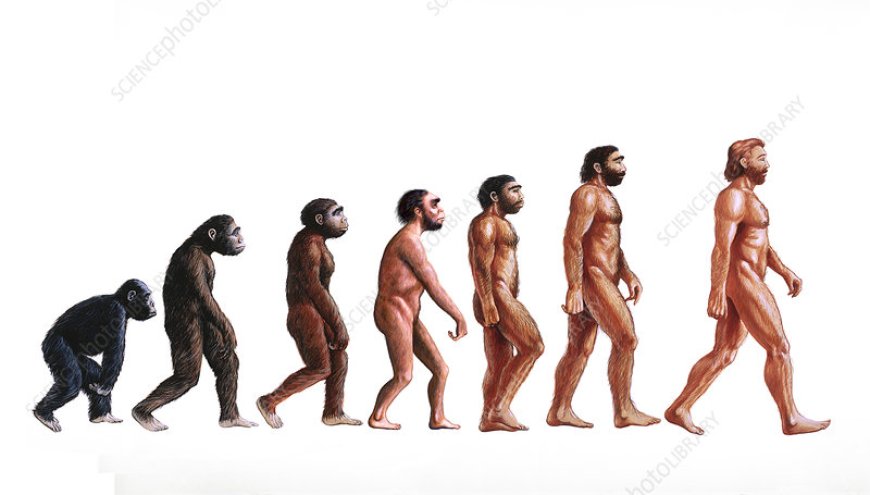
Environmental changes in Africa led to shrinking forests and expanding open landscapes. Around 4.4 million years ago, one primate species made a revolutionary adaptation: walking on two legs. Bipedal movement freed the hands for carrying food, using tools, and caring for offspring. Although walking upright made childbirth more difficult, it also encouraged social cooperation and long-term parental care.
By 3.2 million years ago, our ancestors walked fully upright and had larger brains. As predators became more dangerous, intelligence became the key to survival. Around 2.3 million years ago, Homo habilis appeared, the first species known to make stone tools. Tool use allowed access to new food sources, including bone marrow, and marked the moment humans began actively shaping their environment.
Homo erectus followed, becoming skilled hunters who worked together, controlled fire, and formed social groups. Cooking food made digestion easier, reduced the need for large jaws, and allowed more energy to fuel brain growth. Speech gradually evolved as changes in the throat and tongue made complex communication possible. Language strengthened cooperation and learning, giving humans an unmatched advantage.
Around 200,000 years ago, Homo sapiens emerged. With powerful brains, advanced tools, and language, humans spread across every continent. We adapted to deserts, forests, ice ages, and coastlines, transforming landscapes and building civilizations. After a 3.3 billion-year struggle for survival, humanity became the most influential species on Earth.
The story of mankind is not one of certainty or destiny. It is a fragile chain of survival shaped by chance, adaptation, and resilience. From a single cell in a hostile ocean to a species capable of understanding its own origins, human evolution stands as the most extraordinary story life has ever told.