












The Arrest of Nicolás Maduro: How a US Operation Shook Venezuela and the World
The dramatic arrest of Venezuela’s president Nicolas Maduro by US forces has sparked global outrage, legal questions, and fears of regional instability.

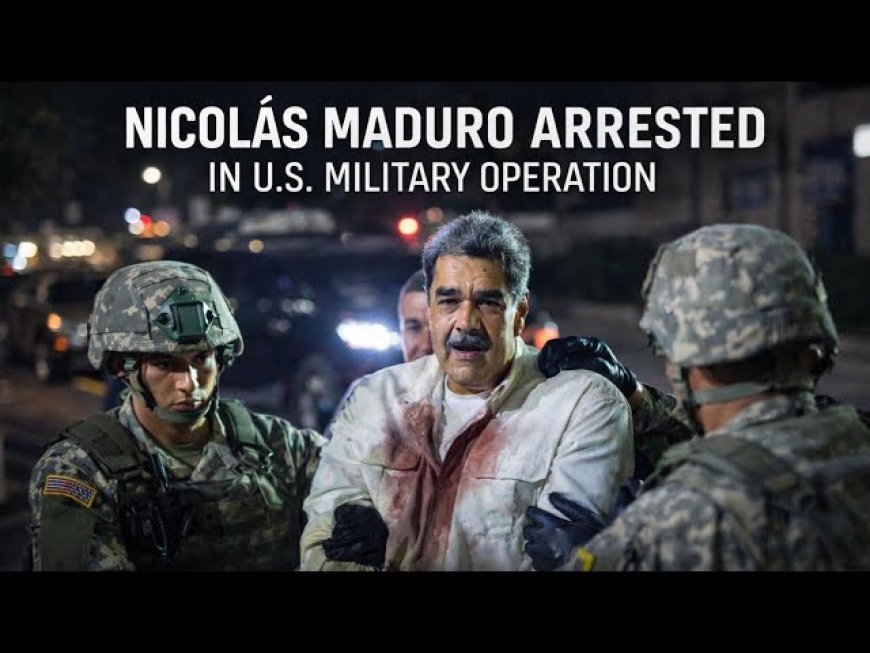
The images spread rapidly across social media. Nicolás Maduro, the long-time strongman president of Venezuela, captured, cuffed, and escorted by US forces. Blindfolded, limping, surrounded by armed soldiers, he was no longer the untouchable leader who had ruled Venezuela for more than a decade.
The Trump administration said the operation was about narco-terrorism. Critics argued it was something else entirely. Oil, power, and influence in Latin America.
What followed was one of the most dramatic foreign interventions in recent history, raising urgent questions about legality, motive, and what comes next for Venezuela and the wider region.
A Shock Operation in Caracas
The operation unfolded with speed and force. Power to Caracas was cut. Explosions were reported across the capital. US helicopters descended on the compound where Maduro was hiding.
According to accounts and mobile phone footage, Maduro attempted to flee but was trapped inside a secure room he could not escape. A large portion of his security detail was killed during the raid. Within hours, Maduro was removed from the country and flown to the United States.
The Trump administration released images of President Donald Trump, Secretary of State Marco Rubio, and Defense Secretary Pete Hegseth watching the operation not from the White House Situation Room, but from Trump’s Florida residence at Mar-a-Lago. Screens displayed live feeds and social media searches related to Venezuela.
Trump later described the operation as “like watching television,” a remark that fueled criticism over the seriousness of the decision.
The Charges Against Maduro
US authorities unsealed an indictment accusing Maduro of narco-terrorism, cocaine trafficking, and illegal weapons possession. The charges also named his wife and son, alleging that drug cartels operated with protection from the Venezuelan government and that narcotics were routed into the United States.
Maduro was transferred to a detention facility before being scheduled to appear in a Manhattan court. The administration framed the arrest as a major victory in the fight against international drug trafficking.
However, many experts questioned the logic. Venezuela is widely considered a transit country rather than a major drug producer. Comparisons were quickly drawn to the case of a former Honduran president convicted of drug trafficking in the US, who was later pardoned by Trump.
Oil, Politics, and Motive
For critics, the arrest had little to do with drugs. Venezuela holds the largest proven oil reserves in the world, and many believe control of those resources lies at the heart of the operation.
Protesters outside the detention center and in cities across Europe and Latin America argued that the intervention was an abuse of power driven by economic interests. Reports emerged that Wall Street executives were already preparing trips to Venezuela to explore investment opportunities.
The operation also aligned with the Trump administration’s stated goal of reasserting influence in the Western Hemisphere, echoing the Monroe Doctrine. Allies on the right, including leaders in Argentina and El Salvador, welcomed the move. Left-leaning governments reacted with alarm.
Political Fallout in the United States
Toppling Maduro had been a long-held ambition of Donald Trump, dating back to his first term. Now realized, the president framed the move as part of an “America First” strategy.
Yet the operation exposed tensions within Trump’s own political base. Many supporters have historically opposed foreign interventions, viewing them as costly and unnecessary. Critics argued that this action followed the same Washington playbook Trump once condemned.
Opponents also questioned the legality of the strike, noting that Congress was not consulted. Some described the raid as an act of war, not a counter-narcotics operation.
A Power Vacuum in Venezuela
Following Maduro’s removal, Venezuela’s vice president, Delcy Rodríguez, assumed leadership under constitutional provisions. However, her position remains fragile.
Rodríguez was one of Maduro’s closest allies and comes from a deeply entrenched communist political background. While she holds the title of president, real power appears fragmented among the military, security services, and armed pro-regime groups known as colectivos.
Observers warn that Venezuela risks sliding into factional conflict. While some citizens celebrated Maduro’s fall, others expressed fear about instability and what the US might do next.
Regional and Global Reactions
Colombia tightened security along its border with Venezuela, though crossings remained open. On the Venezuelan side, reports described a tense calm, with shops open but uncertainty widespread.
Across Latin America, reactions were deeply divided. Argentina supported the US action. Mexico and others condemned it as a violation of international law. Cuba was openly threatened by US officials, intensifying regional anxiety.
In Europe, protests erupted in major cities, while governments struggled to respond. The UK avoided directly condemning the US, stating only that international law matters should be handled by courts.
China and Russia both criticized the operation. Analysts warned that the precedent could embolden other powers to justify similar actions elsewhere, including against Taiwan or Ukraine.
Questions of International Law
Legal experts argue that the operation may have violated the UN Charter. Maduro, regardless of his record, was a sitting head of state and therefore protected by international immunity.
Critics described the arrest as an abduction rather than a lawful extradition. With the US holding veto power at the UN Security Council, consequences appear unlikely. The situation has revived long-standing concerns about the erosion of international norms and the return of power-based foreign policy.
Echoes of Past Interventions
The arrest of Maduro recalled previous US interventions in Latin America, including the 1989 capture of Panama’s leader Manuel Noriega. Human rights groups warned that such actions revive colonial-era dynamics that never fully disappeared.
Retired US General Ben Hodges cautioned that removing a leader is the easy part. Managing what follows, he said, risks becoming an endless conflict if objectives are unclear, drawing parallels with Iraq and Afghanistan.
What Comes Next for Venezuela
President Trump has openly stated his intention to “run” Venezuela and has not ruled out deploying ground troops. Secretary of State Marco Rubio has suggested using oil controls as a means of governance.
Whether this approach is sustainable remains doubtful. Venezuela’s armed forces, paramilitary groups, and Cuban security presence complicate any attempt at external control.
For ordinary Venezuelans, the moment is filled with both hope and fear. After more than a decade of crisis, some see a chance to return home. Others worry that the country may once again become a battleground for global power politics.
A Defining Moment for Global Order
The fall of Nicolás Maduro marks a turning point, not only for Venezuela but for international relations. It raises fundamental questions about sovereignty, legality, and the limits of power.
Whether this operation brings stability or sparks deeper chaos remains uncertain. What is clear is that the consequences will extend far beyond Venezuela’s borders.