






















Why Did the American Civil War Happen?
The American Civil War did not begin overnight. It was the result of decades of political tension, economic division, territorial expansion, and moral conflict. From debates over slavery to violent clashes in new territories, the United States slowly moved toward a breaking point.This article explains why the American Civil War happened, tracing events from the early 1800s through secession and the opening battles of the war.
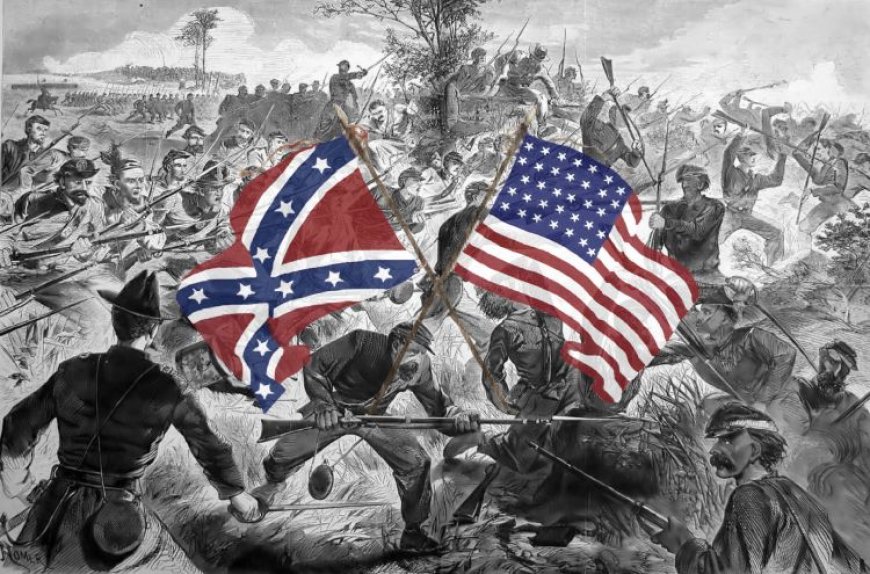
The American Civil War did not begin as a sudden or accidental conflict. It emerged from long-standing tensions that developed over several decades as the United States expanded, changed economically, and struggled to define its national identity. At the heart of the conflict was slavery, but the road to war was also shaped by political compromises, territorial growth, cultural divisions, and repeated failures to maintain unity. By the time fighting began in 1861, the nation had exhausted nearly every peaceful solution available to it.
In the early nineteenth century, the United States existed in a fragile state of balance between free states and slave states. By 1819, there were eleven of each, creating an appearance of equality in Congress and federal decision-making. However, this balance was superficial. Americans were increasingly focused on territorial expansion, driven by the belief that the nation was destined to spread westward across the continent. Although the term Manifest Destiny would only appear later, the idea was already influencing government policy and public opinion. Each new territory raised a critical question that would determine the future of the nation: whether slavery would be allowed or prohibited.
The first major crisis over this issue arose with Missouri’s request for statehood in 1818. Missouri’s desire to enter the Union as a slave state threatened to upset the existing balance, leading to intense debate in Congress. At the same time, Maine sought admission as a free state, offering a possible solution. Under the leadership of Henry Clay, lawmakers crafted the Missouri Compromise of 1820, which allowed Missouri to enter as a slave state and Maine as a free state, while banning slavery in future territories north of the 36°30′ latitude line. Although this compromise temporarily preserved peace, it also institutionalized sectional rivalry by linking every new state’s admission to the issue of slavery.
As westward expansion continued, the pattern established by the Missouri Compromise intensified sectional tensions rather than easing them. Each new state became part of a political trade-off, with slave states and free states admitted in pairs to maintain balance. This fragile system began to collapse as the United States acquired vast new territories, especially after the annexation of Texas and the Mexican-American War. Texas entered the Union in 1845 as a slave state, immediately alarming Northern leaders. The war with Mexico that followed resulted in enormous territorial gains for the United States under the Treaty of Guadalupe Hidalgo. These new lands reignited fierce debates about the expansion of slavery and made compromise increasingly difficult.
In response to growing tension, Congress passed the Compromise of 1850, which attempted to settle disputes arising from the newly acquired territories. While California was admitted as a free state, the compromise also included a strengthened Fugitive Slave Act, requiring citizens and authorities in free states to assist in returning escaped slaves. Additionally, slavery in the remaining territories would be decided through popular sovereignty, allowing settlers to vote on the issue. Rather than resolving the conflict, these measures intensified hostility, especially in the North, where many viewed the Fugitive Slave Act as morally unacceptable.
The application of popular sovereignty soon led to violence, particularly in Kansas. The Kansas-Nebraska Act repealed the Missouri Compromise’s slavery restriction and opened both territories to popular vote. Pro-slavery and anti-slavery settlers rushed into Kansas, each side determined to control its future. The result was a period of brutal violence known as Bleeding Kansas, during which armed clashes, election fraud, and murders became common. This violence made it clear that political solutions were failing and that Americans were increasingly willing to fight over slavery.
The deepening divide between North and South was rooted in fundamental economic and cultural differences. The North had become industrialized, relying on factories, wage labor, and urban growth. Slavery was less central to its economy, allowing many Northerners to question its morality. Abolitionist movements gained strength, supported by religious beliefs and European ideas that viewed slavery as incompatible with modern society. In contrast, the South remained largely agricultural, dependent on enslaved labor to sustain its plantation economy, particularly after the invention of the cotton gin. For many Southerners, the abolition of slavery threatened not only their economy but their entire way of life.
The conflict reached a critical turning point with the Supreme Court’s decision in Dred Scott v. Sanford in 1857. The ruling declared that African Americans were not citizens and that Congress had no authority to prohibit slavery in the territories. This decision outraged the North and convinced many that slavery would continue to expand unchecked. For Southerners, the ruling appeared to validate their position, further entrenching sectional divisions and eliminating hope for a shared constitutional interpretation.
Violence continued to escalate, most notably with abolitionist John Brown’s raid on the federal armory at Harpers Ferry in 1859. Brown intended to spark a slave uprising, but the raid failed, and he was captured and executed. In the North, Brown was seen by some as a martyr for the anti-slavery cause, while in the South he was viewed as a terrorist. His actions deepened Southern fears that abolitionists would use violence to destroy slavery, further pushing the nation toward war.
The final break came with the election of Abraham Lincoln in 1860. Although Lincoln promised not to abolish slavery where it already existed, his opposition to its expansion convinced Southern leaders that their future within the Union was untenable. Beginning with South Carolina, eleven Southern states seceded and formed the Confederate States of America under the leadership of Jefferson Davis. Lincoln refused to recognize secession, insisting that the Union was permanent and must be preserved.
The outbreak of war became inevitable in April 1861, when Confederate forces fired on Fort Sumter, the last remaining Union stronghold in South Carolina. After a two-day bombardment, the fort surrendered, marking the official beginning of the American Civil War. What followed was a conflict far more destructive than either side had anticipated. Early battles such as the First Battle of Bull Run, Wilson’s Creek, and Shiloh revealed the war’s brutality and demonstrated that the struggle would be long and costly.
In conclusion, the American Civil War occurred because decades of compromise failed to reconcile the nation’s opposing views on slavery, economic development, and political power. Territorial expansion repeatedly reopened old wounds, while cultural and moral differences hardened attitudes on both sides. By 1861, the United States had reached a point where unity could no longer be preserved through negotiation alone, and war became the final, tragic outcome of a deeply divided nation.