













A Journey Through Earth’s 4.5-Billion-Year History
Discover Earth’s history condensed into a timeline, from the planet’s formation, oceans, and first life, to dinosaurs, human evolution, and modern civilization.
A Journey Through Earth’s History: From Formation to Modern Humans
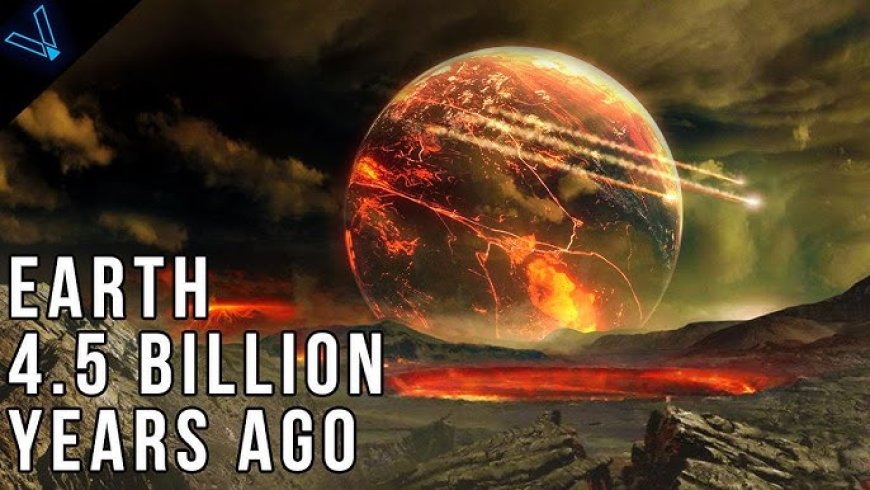
What if we could condense all 4.5 billion years of Earth’s history into a single narrative? From the formation of the planet to the rise of humans, the story of Earth is one of astonishing change, adaptation, and evolution.
Birth of the Earth and the Sun
In the earliest moments, a new star ignites, eventually called the Sun. Around it, dust and gas begin to coalesce, forming a shapeless mass that slowly becomes the planet Earth. Initially, a full rotation of the planet lasted only about six hours. Over time, the gravitational pull of the newly formed Moon gradually slowed Earth’s rotation, lengthening the day.
Formation of the Moon
A Mars-sized planet collides with Earth, creating a massive impact. The debris coalesces into a spherical object: the Moon. This event stabilizes Earth’s axial tilt and plays a crucial role in shaping tides and the planet’s environment.
First Oceans Appear
As Earth cools, water vapor from volcanic activity begins to condense, forming small puddles that gradually grow into stable bodies of water. Comets and water-rich asteroids also deliver additional water. The planet’s surface remains hot, with some lakes reaching boiling temperatures.
First Organic Molecules
Underwater volcanic vents act as natural chemical laboratories. Amino acids, RNA, and proteins form spontaneously in the primordial soup, creating structures capable of self-replication and laying the foundation for life.
First Cells
The first fully formed cells emerge, officially marking the beginning of life on Earth. These simple, single-celled organisms are capable of basic metabolic processes and set the stage for all future life.
Viruses and the Magnetic Field
Shortly after, the first viruses appear. Earth’s core separates into a solid inner layer and a liquid outer layer, generating a magnetic field that protects the planet from harmful solar radiation.
Photosynthesis and Oxygenation
Prokaryotes, such as cyanobacteria, develop photosynthesis, using sunlight to convert carbon dioxide and water into energy, releasing oxygen as a byproduct. This triggers the Great Oxygenation Event, transforming the atmosphere and paving the way for oxygen-based life forms.
Emergence of Eukaryotic Cells
Single-celled organisms engulf others, creating the first eukaryotic cells. Unlike prokaryotes, eukaryotes have a nucleus and specialized organelles, allowing for more complex functions and energy production.
Multicellular Life
Cells begin clustering together to form primitive multicellular organisms. Soon after, fully developed multicellular life appears, including algae and fungi, capable of specialized functions and reproduction.
Snowball Earth
Earth enters a period of global glaciation, known as Snowball Earth. Ice sheets cover the planet, killing most life except for organisms in oceans, hot springs, and ice cracks. Volcanic activity eventually melts glaciers, allowing surviving life to expand into new ecological niches.
Avalon Explosion
Life explodes in diversity. Soft-bodied organisms flourish, followed by the Cambrian Explosion, bringing hard-bodied creatures, trilobites, and the first vertebrates. Evolution experiments with new forms, structures, and survival strategies.
Colonization of Land by Plants
Simple moss-like plants colonize land, stabilizing soil, producing oxygen, and creating habitats for the first land animals.
Land Animals Emerge
Arthropods, ancestors of insects and spiders, move onto land, following plants in search of food and new habitats.
Age of Fish and Amphibians
Oceans thrive with diverse fish species, including armored predators and jawless fish. Lobe-finned fish gradually evolve into amphibians, transitioning from water to land.
Supercontinent Pangaea
The continents converge to form Pangaea, resulting in mountain ranges, tropical coastlines, and new climatic zones.
Reptiles Emerge
Amphibian descendants evolve into reptiles, fully independent of water and capable of inhabiting more environments.
Rise of Dinosaurs
Early dinosaurs appear, diverging into predatory and herbivorous groups. Some develop feathers, eventually giving rise to modern birds.
Flowering Plants and Pollination
Flowering plants evolve, attracting pollinators like insects. This innovation allows for more efficient reproduction and transforms ecosystems.
Dinosaur Extinction
A massive asteroid strike triggers firestorms, darkness, and extreme climate change. Dinosaurs perish, and mammals begin to rise, occupying freed ecological niches.
Mammals and Primates
Small, warm-blooded mammals diversify into multiple niches. Primates evolve with flexible limbs, enhanced vision, and larger brains, leading to early lemurs and other nocturnal tree-dwellers.
Early Hominids
As African forests transition into savannas, bipedal hominids descend from trees. Walking upright frees their hands for tools and promotes intelligence development.
Homo Genus and Modern Humans
Homo habilis appears, followed by Homo erectus, Neanderthals, and Homo sapiens. Humans develop tools, fire, and shelters, eventually transitioning to agriculture during the Neolithic Revolution. Civilization progresses with the construction of monuments, steam engines, and the eventual rise of the internet and AI.
Summary:
This timeline condenses Earth’s 4.5-billion-year history into a continuous narrative, tracing the formation of the planet, the emergence of life, evolution of dinosaurs, mammals, and humans, and the development of modern civilization.