





















Colonial Economy in East Africa: History Notes for Uganda Students
Learn about the colonial economy in East Africa with detailed History notes on cash crops, industries, railways, health services, taxation, and the impacts of colonial rule on modern Uganda, Kenya, and Tanzania.
COLONIAL ECONOMY IN EAST AFRICA
History and Political Education | Lower Secondary, Uganda Curriculum
Introduction
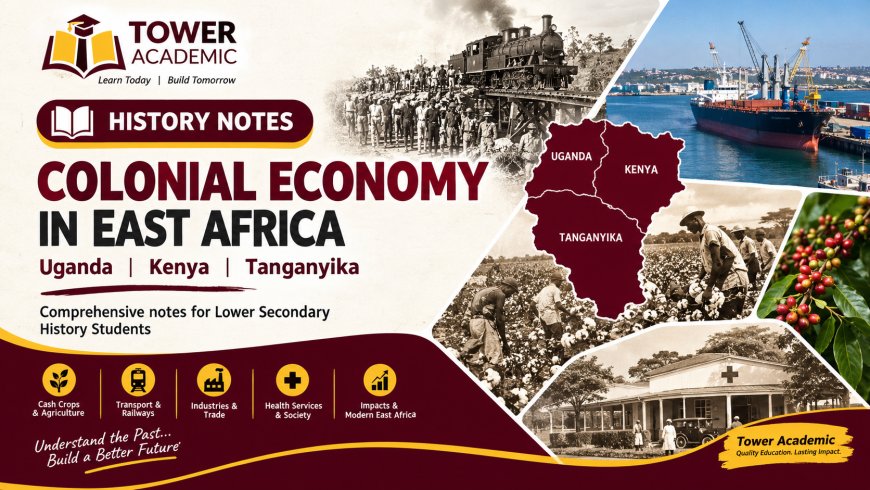
The colonial economy in East Africa refers to the economic system introduced and developed by European colonial powers in the region during the colonial period. It involved the production of agricultural and mineral raw materials, the development of transport and communication networks, the introduction of taxation and wage labour, and the establishment of industries to support colonial trade.
The colonial economy developed mainly in Uganda, Kenya and Tanganyika (present-day mainland Tanzania), although colonial economic activities also affected other parts of East Africa.
The British controlled Uganda and Kenya, while Germany initially controlled Tanganyika. After the First World War, Britain took over the administration of Tanganyika under a League of Nations mandate. Rwanda and Burundi, which had also been part of German East Africa, came under Belgian administration.
The main objective of the colonial economy was to make the colonies economically useful to the colonial powers by supplying raw materials, providing markets for manufactured goods and generating revenue for colonial administration. However, African communities also participated actively in the new economy as farmers, traders, workers and entrepreneurs.
1. Economic conditions in East Africa before the introduction of the colonial economy
Before the establishment of colonial rule, East African societies had well-developed economic activities. Although most communities depended on subsistence production, they also participated in local, regional and international trade.
The pre-colonial economy was not entirely based on subsistence. Some communities produced goods specifically for sale or exchange, while long-distance trade connected the interior of East Africa to the Indian Ocean coast and overseas markets.
1.1 Subsistence agriculture
Most communities practised subsistence agriculture, growing crops mainly to feed their families and communities.
Common food crops included millet, sorghum, bananas, yams, cassava, beans, peas and sweet potatoes.
For example, the Baganda grew bananas, while communities in parts of northern and eastern Uganda cultivated millet and sorghum. Communities in the fertile highlands of Kenya and Tanzania also practised crop farming.
Agriculture was largely organised around family and community labour. Surplus food could be exchanged for livestock, tools, salt and other goods.
1.2 Pastoralism
Pastoralism was an important economic activity among communities that depended mainly on livestock.
The Maasai of Kenya and Tanzania, the Bahima of western Uganda, and the Karimojong of northeastern Uganda kept cattle, goats and sheep.
Livestock provided milk, meat, hides, skins and other products. Cattle also served as a source of wealth, social status and bridewealth.
Pastoral communities exchanged livestock products for agricultural produce and other necessities.
1.3 Fishing
Fishing was practised along Lake Victoria, Lake Kyoga, Lake Tanganyika, Lake Turkana and other water bodies.
Communities living near lakes and rivers obtained fish for food and exchanged surplus fish with neighbouring communities.
For example, fishing communities around Lake Victoria traded dried fish with inland agricultural communities.
1.4 Hunting and gathering
Some communities depended partly on hunting wild animals and gathering fruits, roots, honey, nuts and other products from the natural environment.
These activities provided food, medicines, hides and other materials. They were particularly important in areas where crop farming was difficult.
1.5 Craft industries
Pre-colonial communities produced various goods using locally available materials.
These included:
-
Iron tools such as hoes, knives, spears and axes.
-
Pottery, baskets and mats.
-
Leather products, including sandals, bags and containers.
-
Wooden tools, canoes and household items.
-
Textiles and bark cloth.
For example, ironworking was practised by several communities in the Great Lakes region, while the Baganda produced bark cloth from the bark of the mutuba tree.
Craft production supported agriculture, trade, warfare and domestic life.
1.6 Local and regional trade
Communities exchanged goods through barter and other forms of exchange.
Barter involved exchanging one commodity directly for another without using money.
For example, a farmer could exchange millet for livestock products, salt or iron tools. Markets developed at important meeting points where people exchanged agricultural produce, livestock, crafts and other goods.
Regional trade connected communities in present-day Uganda, Kenya, Tanzania, Rwanda, Burundi and neighbouring areas.
1.7 Long-distance trade
East Africa participated in the Indian Ocean trade network long before European colonial rule.
Coastal towns such as Mombasa, Malindi, Kilwa and Zanzibar connected the African interior to Arabia, Persia, India and other parts of Asia.
African traders supplied commodities such as ivory, gold, animal skins and other products. In return, they obtained cloth, beads, metal goods, ceramics and other imported items.
Zanzibar became an important commercial centre, especially for cloves and the trade in ivory and enslaved people.
This trade contributed to the growth of towns, the spread of Islam and the development of Swahili culture along the coast.
1.8 Limitations of the pre-colonial economy
Despite its achievements, the pre-colonial economy faced several challenges.
-
Production was often limited by the technology available.
-
Most communities depended heavily on rainfall.
-
Long-distance transport was slow and expensive.
-
Roads were generally narrow tracks rather than modern transport routes.
-
Some regions experienced food shortages during droughts and other natural disasters.
-
There was limited mechanised production.
-
Markets were often separated by long distances and political boundaries.
-
Trade in enslaved people caused suffering and insecurity in some areas.
Important point: The colonial economy did not introduce economic activity into an economically inactive region. Instead, it reorganised existing production and trade to serve colonial interests and the international capitalist economy.
2. Introduction of the colonial economy in East Africa
The colonial economy was introduced gradually as European powers established political control over East Africa during the late nineteenth and early twentieth centuries.
The process involved the development of cash-crop agriculture, taxation, wage labour, transport infrastructure, commercial trade and industries.
2.1 Establishment of colonial rule
European colonial powers established administrative systems that enabled them to control land, labour, trade and production.
Britain consolidated its control over Uganda and Kenya, while Germany developed its colonial economy in Tanganyika. British administration replaced German rule in Tanganyika after the First World War.
Colonial governments introduced laws and institutions that regulated African economic activities.
2.2 Introduction of cash crops
Colonial governments encouraged the cultivation of crops that could be sold in international markets.
In Uganda, cotton became an important commercial crop in the early twentieth century. Coffee later became one of the country's leading exports.
In Kenya, European settlers developed commercial farming involving coffee, tea, wheat and other crops. African farmers also grew crops such as maize and cotton.
In Tanganyika, sisal, cotton, coffee, tea and other crops became important commercial products.
Cash crops provided raw materials for industries in Europe and generated export earnings for the colonies.
2.3 Introduction of taxation
Colonial governments introduced taxes payable in money, including hut tax, poll tax and, in some areas, gun tax.
Africans who previously met many of their needs through subsistence production now needed money to pay taxes.
Consequently, many people began growing cash crops, selling agricultural produce or seeking paid employment.
In Kenya, taxation was also used alongside land policies and labour regulations to encourage Africans to work on European-owned farms.
In Uganda, taxation helped expand the monetary economy and encouraged participation in cash-crop production and wage labour.
2.4 Introduction of wage labour
Wage labour involved working for an employer in return for money.
Africans worked on plantations, European farms, railway construction projects, roads, mines, factories and in domestic service.
Some people entered wage employment voluntarily to obtain money, while others faced considerable pressure arising from taxation, land loss, forced labour practices and limited economic opportunities.
Labour migration increased as people moved from rural areas to plantations, towns and industrial centres.
2.5 Development of transport and communication
Colonial governments constructed railways, roads, ports, bridges and telegraph lines.
These facilities connected agricultural and mining areas to markets, administrative centres and coastal ports.
The Uganda Railway, for example, linked the interior of East Africa to the Indian Ocean port of Mombasa. It reduced the cost and difficulty of transporting goods over long distances.
2.6 Introduction of modern banking and currency
Colonial rule expanded the use of money in economic transactions.
Coins and banknotes became increasingly important in paying taxes, wages and purchasing goods.
Commercial banks, currency systems and other financial institutions developed to support trade and investment.
However, access to formal banking and credit was unequal, with many Africans facing restrictions or having limited access to financial services.
2.7 Expansion of commercial trade
Colonial economic policies encouraged the export of raw materials and the importation of manufactured goods.
East Africa exported commodities such as cotton, coffee, tea, sisal, hides, skins and minerals. It imported textiles, machinery, metal products, household goods and other manufactured items.
This increased the region's integration into the world economy, but it also created dependence on overseas markets and imported manufactured products.
3. Features of the colonial economy in East Africa
The colonial economy had several characteristics that distinguished it from the earlier economic system.
3.1 Production of cash crops
Cash-crop production was one of the most important features of the colonial economy.
Farmers produced crops primarily for sale rather than for direct household consumption.
Examples included cotton and coffee in Uganda, coffee and tea in Kenya, and sisal and cotton in Tanganyika.
Although cash crops generated income, dependence on a few export commodities exposed farmers to changes in international prices.
3.2 Export of raw materials
Colonial economies mainly supplied raw materials to industries in Europe and other overseas markets.
Cotton was exported for textile manufacturing, coffee for processing and consumption, and sisal for making ropes and other products.
Minerals such as gold and diamonds were also exported from mining areas.
Much of the processing and manufacturing that generated higher profits took place outside East Africa.
3.3 Importation of manufactured goods
East Africa imported many manufactured products from Europe and other parts of the world.
These included clothes, machinery, metal tools, vehicles and industrial equipment.
Imported goods competed with some locally produced crafts and manufactured products, although local industries continued to exist and later expanded.
3.4 Use of taxation to encourage participation
Colonial governments used taxation to raise revenue and encourage Africans to participate in the money economy.
People needed money to pay taxes, creating an incentive to sell crops or seek paid work.
3.5 Cheap African labour
Many colonial enterprises depended on African labour that was poorly paid.
African workers were employed on plantations, farms, mines, railway construction sites and other projects.
In some territories, colonial governments used compulsory labour, labour recruitment and restrictive laws. In Kenya, land alienation and taxation helped sustain the supply of labour to European farms.
3.6 Land alienation
Land alienation involved taking land from African communities and transferring it to colonial governments, settlers or commercial enterprises.
This was especially significant in Kenya, where fertile areas of the central highlands and Rift Valley were reserved for European settlement.
Land alienation disrupted African farming, reduced access to grazing land and contributed to the growth of migrant labour.
In Uganda, the pattern was different. Much of the cotton economy developed through African smallholder farmers, although plantation agriculture and large estates also emerged.
3.7 Development of plantation agriculture
Plantation agriculture involved cultivating crops on large estates, often using hired labour.
Examples included sisal estates in Tanganyika, European coffee and tea farms in Kenya, and sugar estates in Uganda.
Plantations were usually established to produce crops for commercial markets.
3.8 Development of a transport network
Railways, roads, ports and inland waterways were developed to connect productive areas with export markets.
The network was concentrated along economically important routes, especially those linking agricultural and mining areas to ports.
This encouraged the growth of towns and commercial centres.
3.9 Growth of towns and urban centres
Colonial economic activities encouraged urbanisation.
Towns grew around railway stations, ports, administrative headquarters, mines and industrial centres.
Examples include Nairobi, Kampala, Jinja, Mombasa, Kisumu, Dar es Salaam, Tanga, Mwanza and Tabora.
3.10 Unequal distribution of economic benefits
The benefits of colonial economic development were unevenly distributed.
European companies, settlers, colonial governments and some Asian commercial enterprises controlled significant parts of trade, processing and investment.
African farmers and traders also earned income, but many faced low producer prices, limited access to capital, unequal land policies and poor working conditions.
3.11 Dependence on international markets
Colonial economies depended heavily on overseas demand for agricultural and mineral products.
When international prices fell, export earnings and farmers' incomes could decline.
For example, changes in world demand and prices affected cotton, coffee and sisal producers.
3.12 Limited industrial development
Industrial development was largely concentrated in processing agricultural produce and supplying basic consumer goods.
Cotton ginneries, coffee-curing plants, sugar factories, sawmills and other processing enterprises emerged.
However, the region did not develop a broad industrial base comparable to that of the colonial powers.
4. Reasons why industries were established in colonial East Africa
Industries were established during the colonial period to process agricultural produce, exploit natural resources, supply local markets and support colonial economic activities.
4.1 To process agricultural raw materials
Many industries were established to process crops produced by African farmers and European settlers.
For example, cotton ginneries were established in Uganda to separate cotton fibres from seeds. Coffee-curing factories prepared coffee beans for export, while sugar factories processed sugarcane into sugar.
Processing reduced the bulk of some products and made them easier to transport and sell.
4.2 To increase profits from agricultural production
Processing agricultural produce before export could increase its commercial value.
Instead of exporting unprocessed cotton, ginneries produced cotton lint that could be sold to textile manufacturers.
Similarly, sugar factories converted sugarcane into a finished product that could be sold in local and overseas markets.
4.3 To exploit locally available raw materials
Some industries were established because East Africa had suitable agricultural and natural resources.
Examples included:
-
Cotton-processing industries in Uganda.
-
Sugar factories at Lugazi and Kakira in Uganda.
-
Sisal-processing industries in Tanganyika.
-
Coffee and tea processing in Kenya and Tanganyika.
-
Sawmills in areas with commercial forests.
-
Mining-related processing activities in mineral-producing areas.
The location of industries was often influenced by the availability of raw materials, water, labour and transport.
4.4 To supply manufactured goods to the local population
The growth of towns, plantations, administrative centres and commercial activities created demand for manufactured goods.
Industries producing soap, bricks, furniture, beverages, textiles and other basic products gradually developed.
Some of these industries supplied goods that had previously been imported.
4.5 To reduce the cost of importing manufactured goods
Transporting bulky or heavy products over long distances was expensive.
Establishing industries close to consumers or raw materials could reduce transport costs.
For example, producing bricks, timber products and some food products locally could be cheaper than importing them.
4.6 To create employment
Industries provided jobs for Africans and other residents of East Africa.
Workers were employed as machine operators, mechanics, loaders, clerks, technicians and supervisors.
However, African workers were often concentrated in lower-paid positions, while senior technical and managerial posts were disproportionately occupied by Europeans and Asians.
4.7 To support the railway and other transport systems
Railways and ports created demand for sleepers, timber, repairs, construction materials and other supplies.
Industries also benefited from the railway because it enabled them to transport raw materials and finished goods more efficiently.
4.8 To take advantage of improved transport
Railways, roads and ports made it easier to transport bulky agricultural products to factories and markets.
Industries were therefore often established near railway lines, major roads, towns and agricultural production zones.
4.9 To respond to changes in international trade
International demand for cotton, coffee, sugar, sisal and other products encouraged investment in processing industries.
In addition, interruptions to overseas supplies during the First and Second World Wars encouraged some local manufacturing and processing.
4.10 To expand commercial investment
Merchants and entrepreneurs invested in industries because they saw opportunities to earn profits from growing agricultural and urban markets.
Asian entrepreneurs, including the Mehta and Madhvani business families in Uganda, played important roles in the development of commercial processing and sugar production.
Examples of industries established during the colonial period
|
Industry |
Location |
Main activity |
|---|---|---|
|
Cotton ginneries |
Uganda |
Separating cotton fibres from seeds |
|
Sugar factory at Lugazi |
Lugazi, Uganda |
Processing sugarcane |
|
Kakira Sugar Works |
Kakira, Uganda |
Processing sugarcane |
|
Sisal processing |
Tanganyika |
Preparing sisal fibres |
|
Coffee curing |
Uganda, Kenya and Tanganyika |
Preparing coffee for export |
|
Tea processing |
Kenya and Tanganyika |
Processing tea leaves |
|
Sawmilling |
Forested areas of East Africa |
Processing timber |
The Lugazi sugar factory was established in 1924 under Nanji Kalidas Mehta, while the Kakira sugar factory began operations in 1930 under the Madhvani business enterprise. These developments became important foundations of Uganda's commercial manufacturing sector.
5. Development of the transport system in colonial East Africa
The colonial transport system consisted of railways, roads, ports, inland waterways and, later, air transport.
Its development was closely connected to the need to transport raw materials, imported goods, colonial officials, soldiers and labourers.
5.1 Development of roads
Before colonial rule, most communities used footpaths, tracks and locally maintained routes.
Colonial governments developed roads to connect administrative centres, agricultural areas, railway stations, ports and trading centres.
Road construction increased as motor vehicles became more widely used.
Reasons for constructing roads
-
To transport cash crops and minerals.
-
To connect rural areas to railway stations and markets.
-
To facilitate the movement of colonial officials.
-
To move soldiers and police.
-
To transport imported goods from ports to inland areas.
-
To support plantation agriculture and commercial farming.
-
To connect administrative headquarters.
-
To improve communication between different parts of the colonies.
Examples of road development
In Uganda, roads connected Kampala, Jinja, Entebbe, Mbale, Tororo, Mbarara and other important centres.
In Kenya, roads linked Nairobi and other inland towns to Mombasa and agricultural areas.
In Tanganyika, roads connected Dar es Salaam, Tanga, Mwanza and inland administrative centres.
Roads contributed to the growth of towns and trade. However, some were poorly maintained, and road development was concentrated in economically important areas.
5.2 Development of ports
Ports were important because they connected East Africa to overseas markets.
The major coastal ports included Mombasa in Kenya, Dar es Salaam and Tanga in Tanganyika, and Zanzibar.
These ports handled exports such as cotton, coffee, sisal, hides, skins and minerals, as well as imports such as machinery, textiles and manufactured goods.
Port facilities were improved to handle increasing volumes of international trade.
5.3 Development of inland water transport
Lakes and rivers provided important transport routes.
Steamers and other vessels operated on Lake Victoria and other major lakes, connecting inland towns and trading centres.
Lake Victoria was particularly important because it linked Uganda, Kenya and Tanganyika.
Ports such as Kisumu, Port Bell, Mwanza and Bukoba served as important points for transporting people and goods.
The Nile and other navigable waterways also provided transport in suitable sections, although waterfalls, rapids and other physical obstacles limited navigation in some areas.
5.4 Development of air transport
Air transport developed more significantly during the later colonial period.
Airfields and airports were established to facilitate the movement of colonial officials, passengers, mail and valuable goods.
Entebbe became an important aviation centre in Uganda, while Nairobi and Dar es Salaam also developed important air transport facilities.
Air transport was expensive and initially served a relatively small proportion of the population.
6. The Uganda Railway and its importance to colonial East Africa

The Uganda Railway was one of the most important transport projects undertaken by the British in East Africa. It was constructed to connect the Indian Ocean coast at Mombasa to the interior around Lake Victoria, particularly Uganda.
Despite its name, the original railway from Mombasa to Kisumu ran entirely through what is now Kenya.
6.1 Reasons for constructing the Uganda Railway
To facilitate the movement of colonial officials
The British wanted a reliable transport system for moving officials between the coast and the interior. The railway made it easier to administer Uganda and the surrounding territories.
To strengthen British control over Uganda
Uganda was strategically important because of its position near the source of the River Nile. The British considered control of the region important to their wider imperial interests in the Nile basin and Egypt.
To transport raw materials
The railway was intended to carry cotton, coffee, hides, skins and other products from the interior to the coast for export.
To make imported goods available
It enabled manufactured goods from overseas to be transported from Mombasa to inland markets.
To reduce the cost of transport
Before the railway, many goods were carried by human porters over long distances. Rail transport could carry larger quantities of goods more efficiently.
To facilitate military operations
The railway enabled the colonial government to move soldiers, weapons and supplies more easily.
To promote European settlement
In Kenya, the railway made it easier for European settlers to reach the highlands and transport agricultural products to the coast.
To encourage trade and investment
The railway reduced transport difficulties and encouraged the establishment of trading centres, farms, plantations and industries along its route.
6.2 Construction of the Uganda Railway
Construction began at Mombasa in 1896 and reached Kisumu, then known as Port Florence, in 1901.
The railway was approximately 660 miles (1,060 kilometres) long. It crossed difficult terrain, including the East African coast, the Rift Valley and the escarpments leading to the Lake Victoria basin.
Thousands of workers, including labourers recruited from India and African workers, contributed to its construction.
The project faced serious challenges, including disease, difficult terrain, labour shortages, attacks by wild animals and high financial costs.
The line became popularly known as the Lunatic Express, partly because of the enormous expense and the engineering difficulties involved.
The construction of the railway also contributed to the growth of Nairobi, which developed from a railway construction and administrative centre into a major city.
The main railway reached Kisumu in 1901. The extension towards Kampala began in 1901, and railway services reached Kampala in 1931 after the development of the connecting lines and the Jinja–Namasagali section.
6.3 Development of the railway network in Uganda
The original railway was extended through several stages to connect more parts of Uganda.
|
Year or period |
Development |
|---|---|
|
1896 |
Construction of the Uganda Railway began at Mombasa. |
|
1901 |
The main railway reached Kisumu on Lake Victoria. |
|
1901–1903 |
The Jinja–Namasagali railway connection was developed. |
|
1920s |
Railway construction expanded into eastern Uganda. |
|
1929 |
Kenya and Uganda Railways and Harbours were organised under a joint administration. |
|
1931 |
The railway connection to Kampala was completed. |
|
1950s |
Further extensions, including the Kampala–Kasese line, expanded the network. |
|
1964 |
The northern railway extension towards the West Nile region was completed. |
Historical note: The exact dates of some branch-line developments differ across summaries. The main milestones above distinguish the original Mombasa–Kisumu railway from the later extensions within Uganda.
6.4 Importance of the Uganda Railway to colonial East Africa
1. It promoted agricultural production
The railway encouraged the production of cash crops by providing access to overseas markets.
Farmers could transport cotton, coffee and other commodities more easily.
In Uganda, cotton and coffee production expanded as access to the coast improved.
2. It facilitated international trade
The railway connected the interior of East Africa to Mombasa, an important Indian Ocean port.
This enabled the export of agricultural produce and minerals and the importation of manufactured goods.
3. It reduced transport costs
Transporting goods by rail was generally cheaper and more efficient than relying entirely on human porters over long distances.
This made it easier to move bulky products such as agricultural produce and construction materials.
4. It encouraged the growth of towns
Railway stations became centres of settlement, trade and administration.
Nairobi, Nakuru, Eldoret, Kisumu, Jinja and other towns benefited from railway-related activities.
5. It encouraged industrial development
Industries such as cotton ginneries, coffee-curing plants and sugar factories benefited from improved access to raw materials and markets.
6. It facilitated colonial administration
Colonial officials could travel more easily between administrative centres.
The railway also improved communication and the movement of government supplies.
7. It facilitated military operations
Soldiers and military supplies could be transported more efficiently, helping colonial governments suppress resistance and maintain control.
8. It encouraged European settlement
In Kenya, the railway made the highlands more accessible to European settlers.
It enabled settlers to transport agricultural products to Mombasa and encouraged the development of commercial farms.
9. It promoted labour migration
The railway made it easier for people to travel to plantations, farms, mines, towns and construction sites in search of employment.
It also increased population movement between different parts of East Africa.
10. It contributed to the decline of some forms of porterage
Rail transport reduced the need to carry all bulky goods by human porters.
However, human labour continued to be used for loading, unloading, transporting goods to and from railway stations, and maintaining transport infrastructure.
11. It encouraged the development of communication networks
Railway stations often became centres for postal services, telegraph facilities, commercial information and administrative communication.
12. It strengthened regional economic connections
The railway linked Uganda and inland Kenya to coastal trade. Together with Lake Victoria steamers and other railway lines, it helped develop a connected regional economy.
6.5 Negative effects of the Uganda Railway
Despite its importance, the railway also had negative consequences.
-
Its construction was extremely expensive.
-
Workers faced difficult conditions, including disease, accidents and harsh working environments.
-
The railway supported the export of raw materials rather than the development of a fully diversified industrial economy.
-
In Kenya, railway development encouraged European settlement and the alienation of African land.
-
Some areas were left out of the main railway network, increasing regional economic inequalities.
-
The railway facilitated the movement of colonial troops and strengthened foreign political control.
-
Economic activity became concentrated along railway corridors, leaving some remote areas less developed.
The railway was therefore both an important development in East African transport and an instrument of colonial economic and political control.
7. Colonial health systems in East Africa
Colonial health systems consisted of the medical services, hospitals, dispensaries, research institutions, sanitation programmes and disease-control measures established under colonial governments.
These systems developed gradually. Their coverage was uneven, and they were often designed primarily to protect colonial officials, European settlers, soldiers, commercial workers and the labour force needed by the colonial economy.
Nevertheless, African communities also benefited from medical services, missionary hospitals, vaccination programmes and public health campaigns.
7.1 Reasons for establishing colonial health services
To protect colonial officials and European settlers
European officials and settlers faced diseases that were common in tropical environments. Medical services helped protect their health and maintain the colonial administration.
To protect the labour force
Plantations, mines, railway construction and other economic activities depended on workers. Disease reduced the availability and productivity of labour.
To control epidemics
Diseases such as sleeping sickness, plague, smallpox and malaria could spread rapidly and cause serious population losses.
To promote missionary activities
Christian missionary organisations established hospitals, dispensaries and medical centres alongside their religious and educational work.
To improve sanitation in towns
Urban centres needed measures to manage waste, improve drainage, control disease and protect public health.
To support scientific research
Colonial governments established laboratories and research programmes to study tropical diseases and develop methods of prevention and treatment.
7.2 Development of hospitals and dispensaries
Colonial governments and missionary organisations established hospitals, dispensaries and health centres.
These facilities provided treatment for common illnesses, injuries and infectious diseases.
In Uganda, medical services developed around important administrative centres, including Entebbe and Kampala. Missionary medical institutions also played a significant role.
In Kenya, hospitals and medical facilities developed in Nairobi, Mombasa and other centres.
In Tanganyika, Dar es Salaam and other administrative towns became important locations for colonial medical services.
However, many rural communities had little or no access to formal medical facilities.
7.3 Establishment of medical research institutions
Medical research became important because colonial governments faced diseases that affected both African populations and Europeans.
Researchers investigated malaria, sleeping sickness, yellow fever, plague and other tropical diseases.
In Uganda, Entebbe became an important centre for medical research. The early twentieth-century sleeping sickness epidemic attracted considerable scientific attention.
Research contributed to improved understanding of disease transmission, diagnosis and treatment.
7.4 Control of sleeping sickness
Sleeping sickness, also called human African trypanosomiasis, became a major public health problem in parts of East Africa during the early twentieth century.
The disease is transmitted by infected tsetse flies.
An epidemic that began around 1900 severely affected communities around Lake Victoria, especially in Uganda and neighbouring areas.
Colonial authorities responded through medical examinations, treatment campaigns, attempts to control tsetse flies and, in some areas, the relocation of communities away from affected locations.
These measures helped control the disease in some areas, but some interventions were coercive and disrupted African livelihoods.
The epidemic demonstrates how disease control could serve both public health objectives and colonial economic interests.
7.5 Development of sanitation and public health
Colonial governments introduced sanitation measures in selected towns and administrative centres.
These included:
-
Drainage and waste disposal.
-
Inspection of buildings and markets.
-
Measures to improve the quality of drinking water.
-
Mosquito-control campaigns.
-
Quarantine and isolation during epidemics.
-
Public health regulations.
These measures contributed to the development of modern urban public health systems, although their implementation was uneven.
7.6 Role of missionary organisations
Christian missions established hospitals, dispensaries and maternity services in different parts of East Africa.
Missionary medical work introduced some communities to formal medical treatment and contributed to the training of nurses and other health workers.
Mission hospitals often served rural communities that were far from government medical facilities.
However, access to treatment varied according to location, resources and the availability of trained staff.
7.7 Training of African medical personnel
Over time, colonial health systems trained African nurses, medical assistants, laboratory workers and other health personnel.
African workers became important in the delivery of medical services, particularly in rural areas and disease-control campaigns.
The number of trained personnel remained inadequate in many areas, and senior positions were often dominated by Europeans.
7.8 Limitations of colonial health services
Colonial health systems had several weaknesses.
-
Medical facilities were concentrated in towns and administrative centres.
-
Rural areas often lacked hospitals and trained medical personnel.
-
Services were frequently designed around the needs of colonial officials, settlers and the labour force.
-
Poor sanitation and unsafe water continued to affect many African communities.
-
Medical resources were limited in many districts.
-
Some public health measures involved forced relocation, compulsory examinations or restrictions on movement.
-
Traditional African medical knowledge was sometimes dismissed or marginalised.
Key point: Colonial health services introduced important medical facilities, research and public health practices, but they did not provide equal access to healthcare for all East Africans.
8. Social and health problems faced by colonialists in East Africa
European colonialists faced several social, environmental and health challenges while establishing and administering colonial rule.
These problems affected European officials, settlers, missionaries, railway workers and other people involved in colonial activities. Many of the same problems, often more severely, affected African communities.
8.1 Tropical diseases
European colonialists were exposed to diseases that were common in tropical East Africa.
Malaria was a major threat, particularly before effective prevention and treatment became widely available.
Other diseases included sleeping sickness, yellow fever, dysentery, cholera and various intestinal infections.
These illnesses caused sickness, deaths, staff shortages and interruptions to economic activities.
8.2 Difficult climatic conditions
Some Europeans found the tropical climate difficult to tolerate.
High temperatures, humidity, heavy rainfall and seasonal variations could affect health and working conditions.
The cold, wet conditions experienced in parts of the Kenyan highlands also created challenges for railway construction workers.
8.3 Inadequate medical facilities
In the early colonial period, hospitals, laboratories and trained medical personnel were limited.
People working in remote areas could be far from medical assistance.
This increased the risks associated with disease, accidents and injuries.
8.4 Difficult terrain
Mountainous areas, forests, swamps, steep escarpments and rivers made movement difficult.
Railway construction through the Rift Valley and other difficult landscapes required considerable engineering effort.
Poor transport also delayed the delivery of medical supplies, food and other necessities.
8.5 Shortage of skilled labour
Colonial governments faced shortages of trained engineers, doctors, mechanics, administrators and other skilled workers.
Many technical personnel had to be recruited from overseas, increasing the cost of colonial projects.
8.6 Communication difficulties
Before the expansion of telegraph lines, railways and roads, communication between the coast and the interior was slow.
This made it difficult to coordinate administration, trade, military operations and emergency medical responses.
8.7 Resistance from African communities
Colonial economic policies often interfered with African land rights, political authority, labour practices and traditional economic activities.
Resistance to colonial rule made it difficult for colonial governments to establish control and implement economic policies.
Examples included the Nandi resistance in Kenya, the Maji Maji Rebellion in Tanganyika and various forms of resistance in Uganda.
8.8 Labour shortages and migration
Colonial enterprises required large numbers of workers.
However, Africans had their own farms, livestock, families and economic activities. Some were reluctant to work for low wages on plantations or construction projects.
Colonial governments and employers therefore used taxation, recruitment and other measures to obtain labour.
8.9 High cost of infrastructure
Railways, roads, ports, hospitals and administrative buildings required substantial financial investment.
The Uganda Railway was particularly expensive because of its length, difficult terrain and the need to import much of its construction equipment.
8.10 Social and cultural differences
Colonialists encountered different languages, political systems, customs, beliefs and economic practices.
Misunderstandings and conflicts arose when colonial policies interfered with established social and cultural systems.
In some cases, colonial administrators relied on African chiefs and other local authorities to facilitate administration and economic production.
9. Impacts of the colonial economy on East Africa
The colonial economy had both positive and negative effects. Its consequences varied between Uganda, Kenya and Tanganyika because the territories had different natural resources, colonial policies, labour systems and patterns of agricultural production.
9.1 Positive impacts
1. Development of transport infrastructure
Railways, roads, ports and bridges improved the movement of people and goods.
These facilities laid the foundation for many of the transport networks used in East Africa today.
For example, the railway connection between Mombasa and the interior remains historically important to regional trade.
2. Expansion of commercial agriculture
Cash-crop production expanded significantly.
Uganda developed a strong cotton and coffee economy. Kenya expanded coffee, tea and other commercial crops, while Tanganyika became an important producer of sisal, cotton and coffee.
These crops continue to contribute to agricultural production and export earnings in the region.
3. Growth of towns and cities
Railways, ports, plantations, administrative centres and industries encouraged urban growth.
Nairobi developed around the railway, while Kampala, Jinja, Dar es Salaam, Mombasa and other towns expanded through commercial and administrative activities.
These centres remain important economic hubs today.
4. Introduction of modern industries
Colonial-era processing activities contributed to the development of manufacturing.
Cotton ginneries, coffee-curing plants, sugar factories and sisal-processing enterprises created a foundation for some modern industries.
For example, Uganda's sugar industry developed around enterprises at Lugazi and Kakira.
5. Growth of regional and international trade
The colonial economy connected East Africa more closely to international markets.
Farmers and traders gained opportunities to sell agricultural produce and purchase goods from other parts of the world.
The development of ports, railways and commercial centres supported the expansion of trade.
6. Introduction and expansion of formal banking
The use of money, commercial banking and formal financial services expanded.
These institutions supported commercial transactions, investment, savings and business development.
However, access to financial services was not equal for all communities.
7. Development of formal employment
The colonial economy created wage-earning opportunities in transport, agriculture, mining, administration, health services and industries.
These jobs contributed to the growth of a wage-earning population and new occupational groups.
8. Development of technical skills
Railway construction, industrial processing, medical services and administrative work created demand for skilled labour.
Some Africans acquired technical, clerical, medical and commercial skills that became useful after independence.
9. Development of formal medical services
Hospitals, dispensaries, laboratories and public health programmes introduced new approaches to disease prevention and treatment.
Some of these facilities and practices became part of the health systems of independent East African states.
10. Expansion of agricultural research
Research institutions and agricultural extension programmes were developed to improve the production of commercial crops.
Some research centres established during the colonial period continued to support agriculture after independence.
11. Improved communication
Telegraph lines, postal services, railways and roads improved communication between towns and administrative centres.
These developments supported commerce, government administration and social interaction.
12. Growth of commercial entrepreneurship
Some African and Asian traders developed successful businesses in crop buying, transport, processing and retail trade.
In Uganda, Asian entrepreneurs played a major role in cotton ginning and sugar processing, while African farmers and traders also participated in the commercial economy.
9.2 Negative impacts
1. Exploitation of African labour
Many African workers received low wages and worked under difficult conditions.
Some colonial governments used compulsory labour, while taxation and other policies pressured Africans to seek wage employment.
This reduced the freedom of many people to choose how and where they worked.
2. Loss of African land
Land alienation deprived some African communities of fertile farmland and grazing areas.
The problem was particularly severe in Kenya, where large areas of fertile land were reserved for European settlers.
Displacement reduced the land available for African agriculture and contributed to rural poverty and labour migration.
3. Decline of some traditional industries
Imported manufactured goods competed with locally produced crafts and other traditional products.
Some local producers found it difficult to compete with cheaper or mass-produced imports.
However, traditional crafts did not disappear completely and continued to serve local markets.
4. Dependence on cash crops
Many areas became dependent on a small number of export crops.
Uganda became strongly associated with cotton and coffee, while sisal became particularly important in Tanganyika.
Dependence on a few commodities made farmers vulnerable to changes in international prices and demand.
5. Unequal distribution of wealth
The benefits of colonial economic growth were distributed unevenly.
European settlers, overseas companies, colonial governments and some commercial enterprises controlled important resources and activities.
Many African workers received low wages, while smallholder farmers faced limited access to credit, processing facilities and profitable markets.
6. Development of regional inequalities
Areas near railways, ports, plantations and administrative centres often developed faster than remote areas.
In Uganda, the Lake Victoria region and the central transport corridor gained considerable commercial importance.
In Kenya, the railway corridor and the highlands attracted major investment.
These patterns contributed to long-term differences in economic opportunities between regions.
7. Destruction and disruption of traditional economic systems
Colonial taxation, land policies, labour recruitment and cash-crop production changed traditional patterns of production and exchange.
Some communities lost access to land or were drawn into wage labour and commercial farming.
These changes affected family responsibilities, social relations and traditional livelihoods.
8. Growth of rural-to-urban migration
People moved to towns and commercial centres in search of employment.
Although migration created new opportunities, it also contributed to overcrowding, poor housing, inadequate sanitation and the growth of informal settlements in some urban areas.
9. Environmental degradation
Commercial agriculture, mining, logging, railway construction and settlement expansion affected the environment.
Some areas experienced deforestation, soil erosion, loss of wildlife habitats and pressure on land and water resources.
10. Limited industrial diversification
Colonial industries concentrated mainly on processing raw materials and producing basic goods.
East Africa therefore remained dependent on imports for many machinery, manufactured products and advanced industrial goods.
11. Economic dependence on overseas markets
Colonial economies were closely tied to external markets.
When demand or prices for major exports fell, farmers, traders and colonial governments experienced financial difficulties.
12. Unequal access to education and technical training
Formal education and technical training expanded, but access was uneven.
The colonial economy required clerks, teachers, medical assistants and other trained workers, yet educational opportunities varied by region, gender, social background and type of institution.
This affected the distribution of skills and employment opportunities.
10. How the colonial economy influenced the development of modern East Africa
The colonial economy left a lasting legacy. Some of its institutions and infrastructure became useful foundations for independent development, while other features contributed to persistent economic challenges.
10.1 Modern transport networks
Many roads, railway routes, ports and urban transport corridors developed during the colonial period remain important today.
The Mombasa transport corridor continues to connect Kenya's coast with inland markets, including Uganda and other landlocked countries.
The colonial railway network also influenced the location of towns, warehouses, industrial sites and commercial centres.
Modern governments have expanded and rehabilitated these networks to support regional trade.
10.2 Continued importance of cash crops
Crops promoted during the colonial period remain important to East African economies.
-
Uganda continues to earn export income from coffee, cotton, tea and other agricultural products.
-
Kenya remains an important producer and exporter of tea and coffee.
-
Tanzania continues to produce coffee, cotton, tea, sisal and other commercial crops.
The difference is that independent governments and local producers now make many of the decisions about production, marketing and trade.
10.3 Growth of modern manufacturing
Some industries established during the colonial period continued to develop after independence.
Uganda's sugar industry is an example of an industrial activity with roots in the colonial era.
Modern manufacturing has expanded into food processing, beverages, cement, textiles, construction materials and other sectors.
However, East African countries continue to seek greater industrial diversification and value addition.
10.4 Development of modern urban centres
Cities such as Kampala, Nairobi, Mombasa, Dar es Salaam, Jinja and Kisumu developed partly because of colonial transport, administration and commercial activities.
Today, they serve as centres of government, finance, education, manufacturing, trade and transport.
Their growth has also created challenges involving traffic congestion, housing, sanitation, unemployment and pressure on public services.
10.5 Development of modern banking and commercial systems
Colonial-era monetary systems, commercial institutions and trading networks influenced the development of modern financial systems.
Independent East African countries developed their own central banks, currencies, commercial banks and financial regulations.
These institutions now support trade, investment, public finance and private enterprise.
10.6 Regional trade and economic integration
Colonial transport and commercial networks helped connect different parts of East Africa.
After independence, regional governments continued to develop cross-border trade and cooperation.
The modern East African Community promotes cooperation in trade, transport, investment and other sectors.
The historical railway and port connections are still relevant to regional economic integration.
10.7 Modern health systems
Hospitals, medical training, laboratories, public health administration and disease-control programmes developed during the colonial period influenced post-independence health systems.
Independent governments expanded healthcare services, trained more health workers and developed national health policies.
Nevertheless, inadequate funding, unequal access to facilities and shortages of personnel remain challenges in some areas.
10.8 Agricultural research and extension
Colonial agricultural research and crop marketing systems influenced the development of modern agricultural institutions.
Today, agricultural research, extension services, improved seeds, irrigation and farmer training are used to improve productivity and food security.
Modern agricultural policy increasingly seeks to balance export production with food security, rural incomes and environmental protection.
10.9 Continuing regional inequalities
The concentration of colonial infrastructure in selected areas contributed to differences in economic development.
Areas with good transport links, fertile land, commercial farms and administrative centres often attracted more investment.
Modern governments continue to address these inequalities through road construction, electricity expansion, industrial parks, education and other development programmes.
10.10 Continuing dependence on raw-material exports
One of the most important colonial legacies is the export of agricultural and mineral products with limited processing.
Exporting raw materials can generate income, but processing them locally can create more jobs, develop skills and increase the value earned within the country.
Modern East African governments therefore promote agro-processing, manufacturing, mineral beneficiation and other forms of value addition.
10.11 Employment and labour systems
The colonial economy contributed to the growth of wage employment and modern labour markets.
Today, employment includes formal jobs in government, manufacturing, banking, transport, education and healthcare, alongside farming and informal work.
Modern labour laws, trade unions and employment policies seek to protect workers' rights, although low wages, unemployment and insecure work remain challenges.
10.12 The need for economic diversification
The colonial economy concentrated on a relatively narrow range of export commodities.
Modern East African countries are working to diversify into manufacturing, tourism, information technology, renewable energy, logistics and other sectors.
Diversification can reduce dependence on a few commodities and make economies more resilient to international price changes.
11. Comparison between the pre-colonial and colonial economies
|
Aspect |
Pre-colonial economy |
Colonial economy |
|---|---|---|
|
Main purpose |
Meeting household needs, local exchange and regional trade |
Export production, colonial revenue and commercial profit |
|
Agriculture |
Mainly subsistence, with some commercial production |
Greater emphasis on cash crops and commercial farming |
|
Labour |
Family, community and other locally organised labour systems |
Wage labour, migrant labour and, in some places, forced labour |
|
Transport |
Footpaths, tracks, canoes and human porterage |
Railways, improved roads, ports and steamships |
|
Industries |
Craft production and small-scale processing |
Commercial processing and selected manufacturing |
|
Trade |
Local, regional and long-distance trade |
Greater integration into international capitalist markets |
|
Money |
Barter and various forms of exchange, alongside money in some areas |
Wider use of colonial currencies and formal monetary systems |
|
Land |
Managed under diverse African customary and political systems |
Greater state control, commercial land acquisition and settler land alienation in some territories |
|
Markets |
Local and regional markets, alongside overseas trade |
Stronger links to overseas markets and imported manufactured goods |
Note: This is a general comparison. Pre-colonial East Africa had commercial farming, specialised industries and long-distance trade, while colonial economic systems differed considerably between Uganda, Kenya and Tanganyika.
12. Revision questions
Conclusion
The colonial economy transformed East Africa by introducing large-scale cash-crop production, wage labour, modern transport networks, commercial processing industries and formal monetary systems. It also encouraged the growth of towns, international trade and new employment opportunities.
However, these developments were largely organised around colonial interests. Land alienation, labour exploitation, unequal access to resources, dependence on raw-material exports and regional inequalities became important features of the colonial economic experience.
Modern East Africa inherited both the opportunities and the challenges created by this system. The region's development therefore depends not only on maintaining useful infrastructure and commercial institutions, but also on expanding local manufacturing, improving working conditions, promoting balanced regional development and increasing the value of locally produced goods.
Sources and further reading
The notes draw on the two resources you supplied, the attached textbook image and additional historical research. The Scribd presentation could not be retrieved in full, and Yaaka restricted access to its page, so I have supplemented them with accessible sources.
-
Uganda Railways Corporation: Our History. Railway development in Uganda and the history of the railway network.
-
Kenya Railways: History. Historical milestones of the Uganda Railway and its development in Kenya.
-
New Vision: How colonial rule reshaped Uganda's economy. Cash crops, cotton processing, coffee and sugar industries.
-
Rural livelihoods and agricultural commercialisation in colonial Uganda. Academic research on cash-crop production, labour, taxation and the long-term economic effects of colonial rule.
-
Sleeping Sickness Epidemics and Colonial Responses in East and Central Africa. Research on colonial medical services, sleeping sickness and public health interventions.
-
World Bank: Agricultural Policy in the Colonial Period. Research on colonial agricultural policies, European settlement, taxation and land.
-
Yaaka: Chapter 2, The Colonial Economy in East Africa. Your supplied curriculum resource.
-
Scribd: Colonial Economy in Uganda. Your supplied presentation.